


What "AI-Powered" Actually Means in Hotel Sustainability Software



What "AI-Powered" Actually Means in Hotel Sustainability Software
Every hotel sustainability platform now claims to be "AI-powered." Most mean they added a chatbot. Here's what AI actually does inside BeCause — and what it doesn't do.
Why hotel sustainability data is a hard problem for AI to solve
Before the AI part makes sense, the underlying data problem needs to be clear.
Hotels typically manage five or more sustainability frameworks at a time, across 1.5 reporting cycles per year. Each framework has its own question formats, methodology definitions, and submission timelines. Certifications, including Green Key, GSTC, and ISO 14001, run on separate tracks with their own audit requirements and renewal schedules. Corporate travel proposals add a third layer, asking for structured sustainability data in a format that doesn't map cleanly to either.
The result: sustainability teams spend most of their time moving data between systems. Copying figures from energy invoices into spreadsheets. Answering the same questions in different formats for different partners. Chasing other departments for data that should already exist in one place.
10% of RFPs are returned because sustainability data is missing or incomplete.
Customer research, 2025.That's not a performance gap. It's a data management gap — the specific problem AI can help close, at the points in the workflow where manual effort is highest and error risk is greatest.
The four ways AI shows up in hotel sustainability data management
AI that reads utility invoices so you don't have to
When a hotel uploads a utility bill, energy invoice, or similar document, AI reads it and extracts the figures, then maps those figures to the correct data fields in the platform. Two separate models handle the job: one reads and classifies the document, one connects the output to the right data points in the hotel's sustainability profile.
The practical result: no manual data entry for metered consumption data. The invoice goes in, structured data comes out.
Live in BeCauseAI that explains what certification criteria are actually asking
Certification documentation is written for auditors. It's not always clear to the hotel operations teams who have to answer it. Within supported certifications, hotels can click "Explain this question" next to any criterion and receive AI-generated guidance: what it's asking for, why it matters for the certification, and what evidence is typically required. A sidebar chat handles follow-up questions.
This is question-level guidance, not an AI consultant. The aim is to cut the back-and-forth with certification bodies for hotels encountering a standard for the first time.
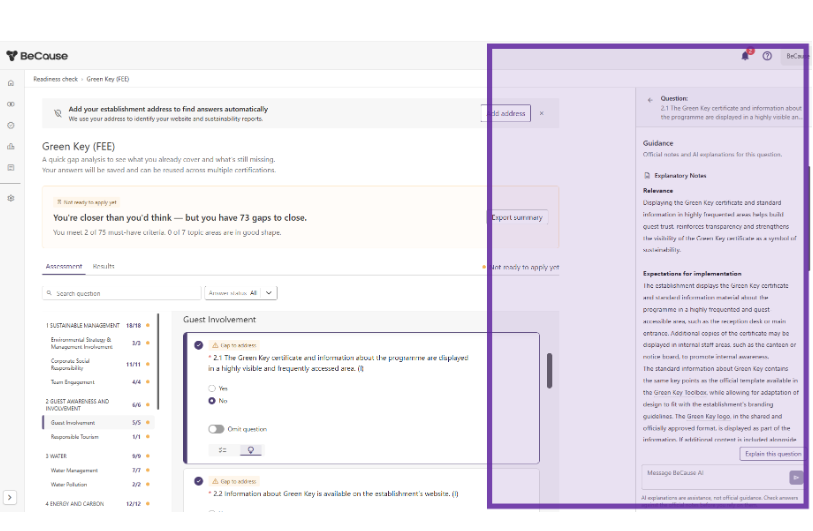
What the hotel sees
Each certification question has a side panel with two layers: the official explanatory notes from the certification body, and AI-generated context on why the criterion matters and what evidence is typically expected.
"Explain this question" opens a direct chat with BeCause AI — scoped to that criterion, not a general assistant.
AI that shows where you stand and what to fix first
The certification readiness check processes a hotel's answered and unanswered must-have questions for a given certification and produces two outputs: what the property already meets, and what's still missing. Each gap gets a quick-win score based on effort level, with the three easiest wins surfacing first. The result is a prioritised action plan, not a raw checklist.
The AI strategy briefing takes this further. Currently in beta and available per property only, it aggregates a hotel's full data profile and generates a structured sustainability summary that hotels can query directly. Ask it follow-up questions; it answers from the property's actual data, not generic benchmarks.
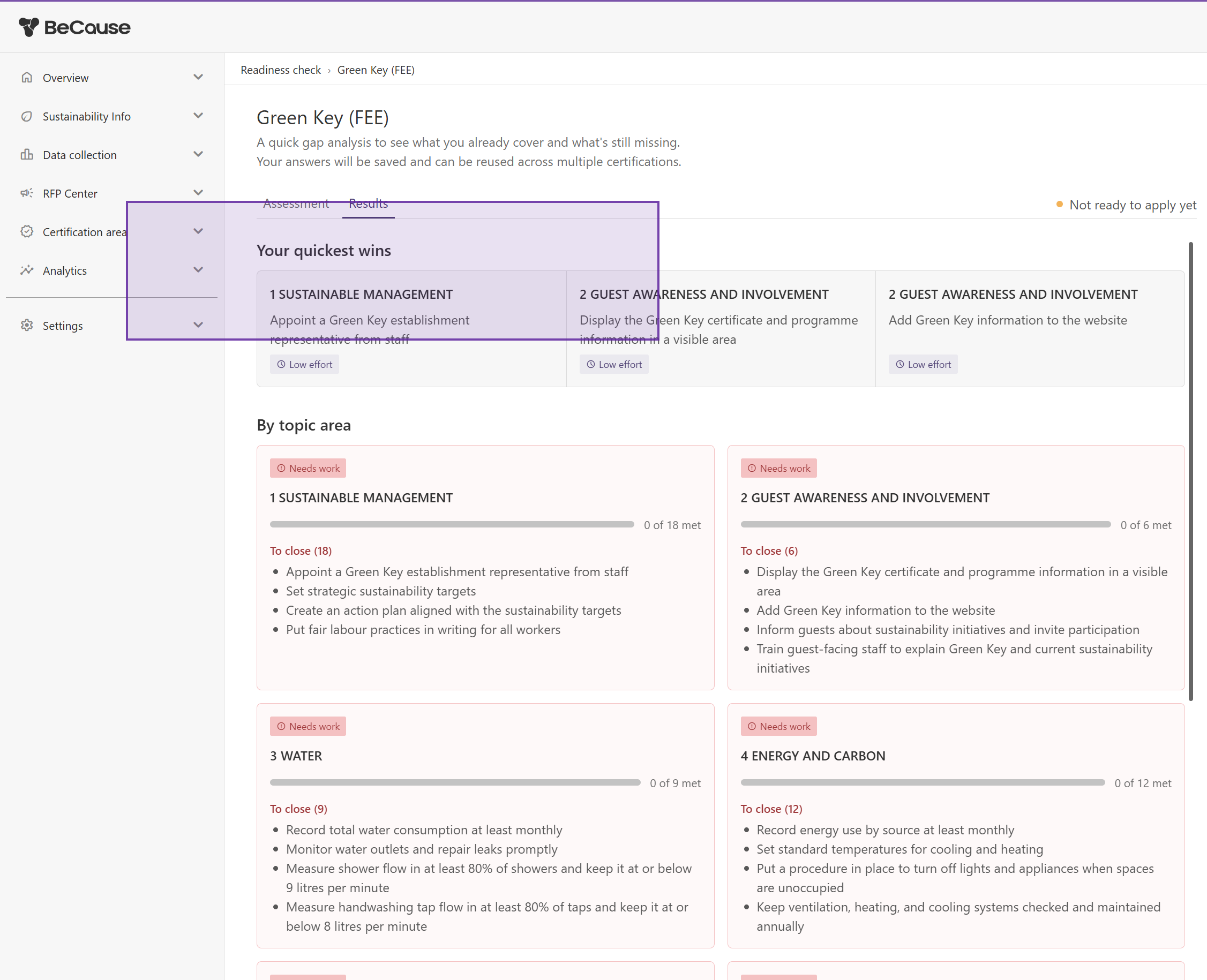
Green Key (FEE) readiness check — Results view. BeCause surfaces the three lowest-effort wins first, then breaks down every gap by topic area with a count of criteria still to meet.
Live in BeCauseAI that handles the unglamorous work at scale
Two features that rarely appear in a product demo but carry weight in large-scale operations:
Hotel matching: when a certification body or travel partner sends BeCause a list of hotels (names and addresses, often inconsistently formatted across thousands of records), a matching algorithm identifies the correct property in BeCause's database. Where the algorithm can't decide between two candidates, AI acts as the tie-breaker. This is what keeps sustainability data accurate across large portfolios without manual reconciliation.
Smart Query: users managing large property volumes can type a plain-English request like "certified members expiring this quarter" or "properties in Denmark added in the last 30 days", and BeCause builds the correct filter, column selection, and sort order automatically. No filter-building, no manual configuration. Particularly useful for certification coordinators and chain-level sustainability leads.
Live in BeCauseWhat separates useful AI from a marketing claim
Across the four features above, a consistent pattern holds: AI does the first pass, a human confirms the result.
Strategy briefings (the tool that aggregates a hotel's full data profile and generates a structured sustainability summary) carry a clear AI-generated label, with a prompt to review before acting on recommendations. Certification question explanations direct hotels to check official documentation. Hotel matching runs a deterministic algorithm; AI steps in only when it can't decide between two candidates.
This matters for a specific reason in the sustainability space: data that flows into certifications, corporate travel buyer responses, and distribution channels needs to be accurate. Greenwashing risk doesn't come only from deliberate exaggeration. It also comes from AI-generated outputs that went unchecked through a workflow with no human review step.
Any hotel sustainability software claiming fully autonomous AI, with no human confirmation step, is describing a workflow most sustainability directors wouldn't want running on their certification data.
What this adds up to in hours and outcomes
The time savings below come from the data workflow these AI features sit inside, not from any single feature in isolation. What customers report across implementations:
- 87% reduction in time spent on certification tracking
- RFP response time cut from 45–60 minutes to around 30 minutes
- 54 Green Key certification applications completed in 24 hours via Certification Co-pilot
- Approximately 350 hours of annual manual mapping eliminated for one travel partner
Taken together, these features address the same underlying problem: sustainability teams spending hours moving data instead of acting on it. The AI doesn't remove the sustainability function. It removes the parts that were grinding it to a halt.
See how BeCause centralizes your sustainability data and where AI fits into that workflow.
Book a 20-minute walkthrough →No prep needed.


More resources.


No spam, ever. Unsubscribe anytime.