A step-by-step process for turning fragmented property-level sustainability data into a clean, auditable, ESG dataset (which the hotel group can use), without doubling your team's workload.
Standardizing sustainability data across a hotel portfolio is genuinely difficult. Most hotels are already collecting some version of it. The problem is getting it out of 40 different spreadsheets, a handful of email threads, and three incompatible property management systems, and making it mean the same thing across every property you operate.
This is the core challenge for a hotel chain's sustainability data management, and it's the reason so many multi-property groups are still assembling their ESG reports manually.
Below is a practical, step-by-step process for fixing that, from data audit through to a distributable, framework-mapped dataset ready for group-level use.
- Audit first. Most chains have more data than they think — it's just sitting in the wrong places.
- One owner per property. Accountability at property level is what makes chain-level accuracy possible.
- Lock your taxonomy before collecting anything new. Inconsistent definitions make aggregation impossible.
- Map frameworks once. Data entered for one framework should auto-populate every other — not be re-entered manually each cycle.
- Pull certification status from the source. Email-based confirmation is why chains are always working with outdated records.
- Replace the spreadsheet. Structured workflows that assign, track, and timestamp inputs are the only thing that scales past 50 properties.
- Build your audit trail from day one. Chain-level ESG data without one isn't publishable — and auditors, RFP teams, and certifiers will all ask for it.
Collecting sustainability data across hotel chains is difficult because each property typically operates its own systems, uses different data definitions, and reports at different intervals. There's no shared taxonomy, no single collection point, and no mechanism to check whether a property in one region is measuring energy the same way as one in another. The result is data that cannot be meaningfully aggregated: inconsistent units, missing fields, outdated certification status, and no audit trail. Chain-level reporting requires all of this to be resolved before a single number can be published externally.
Audit the data you actually have, property by property
Before you can standardize anything, you need an honest picture of what exists. Most hotel chains discover they have more data than they thought, but that it's sitting in the wrong places and owned by the wrong people.
Run a quick data audit across your portfolio. For each property, you're looking for:
- Energy, water, and waste consumption data, including how far back records go
- Active certifications and their current status (including expiry dates)
- Any ESG frameworks the property is already reporting against
- Where that data lives: PMS, spreadsheet, email, paper, or a mix
- Who collected it, and when
This step is usually uncomfortable. Gaps become visible fast. You can't close gaps you haven't mapped.
Assign a single data owner per property
Sustainability data collection fails at the property level for one consistent reason: nobody owns it. The general manager thinks the operations team is handling it. The operations team thinks someone in finance is pulling the utility bills. Nobody is.
Fix this before you build any system. Assign one named person per property who is responsible for data accuracy and submission. That person doesn't have to collect everything themselves. They coordinate across departments, but they're accountable for what gets submitted and for its completeness.
At chain level, your sustainability team manages the framework and the aggregation. At property level, one owner manages the input. The split sounds simple because it is, and it's the first structural fix that compounds quickly.
Establish a shared data taxonomy before collecting anything new
The reason sustainability data can't be aggregated across most hotel chains is definition, not volume. Property A reports energy intensity per occupied room. Property B reports total kWh consumed. Property C hasn't touched its meters since the last audit.
You need a shared taxonomy: a defined list of what each metric means, what unit it's measured in, how it's calculated, and what time period it covers. This is not glamorous work, but it's the foundation everything else sits on.
Pick one primary framework to anchor your taxonomy. Hotel Sustainability Basics is a practical starting point for most chains, designed for operational alignment across properties rather than just reporting. GSTC and GBTA both work as anchors if you have specific OTA or corporate travel requirements. The framework you pick shapes which fields become mandatory. Lock that down first, then layer additional frameworks on top.
Map your frameworks once, not on every reporting cycle
Most chains reporting against multiple standards and data requests are doing the translation work manually. Same data, re-entered four times in four different formats. That's where the hours go.
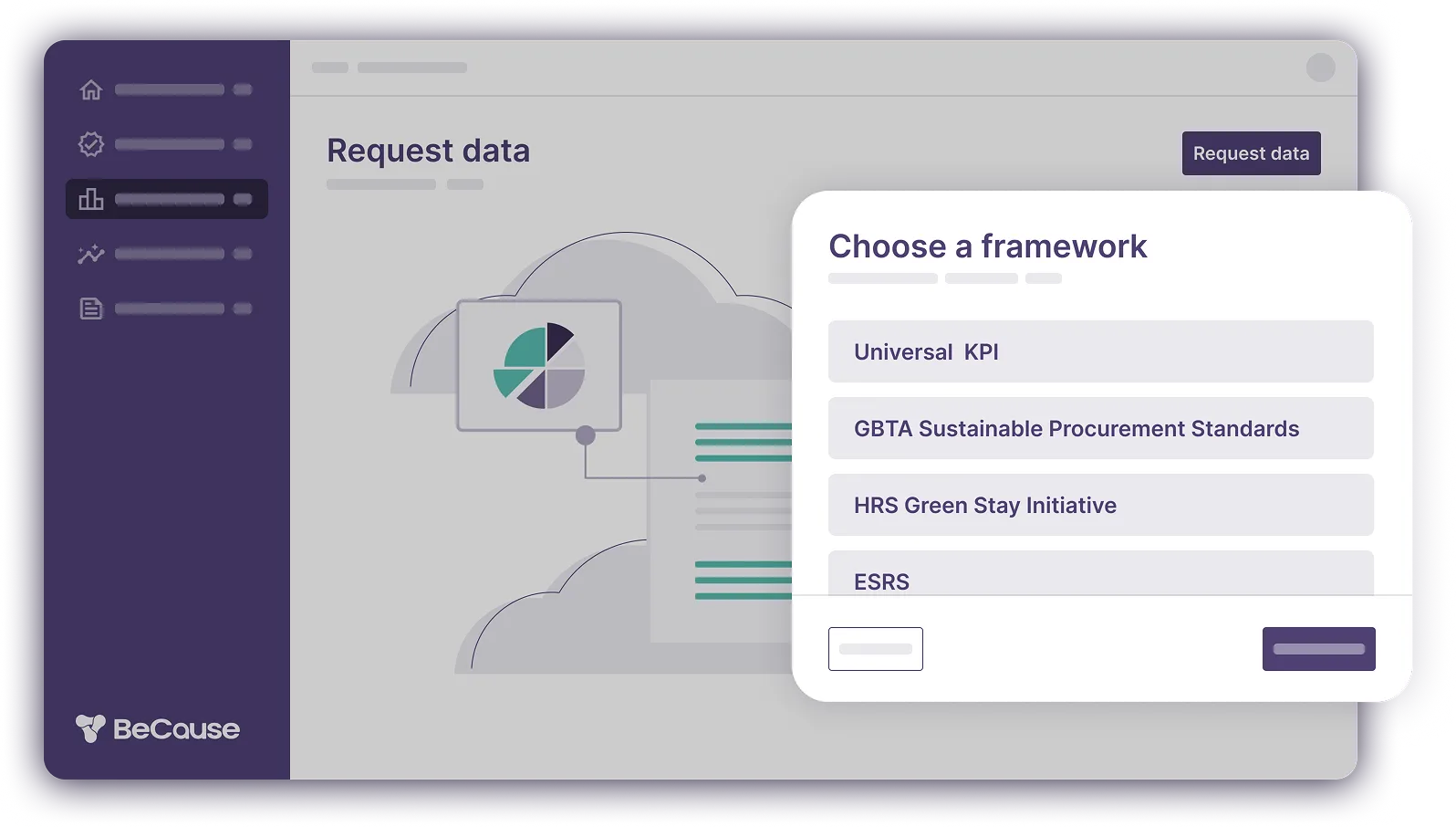
The correct approach is to configure the framework mapping once, at the platform level, so that data entered for one framework automatically populates the overlapping fields in every other. When methodologies update (GBTA, for instance, has updated its calculation approach recently), the logic updates in the platform and pushes through automatically. Your properties don't have to resubmit anything.
"If the GBTA questions change — which they're expected to update next year — that pushes through automatically. We don't have to do anything on our side. And when calculation methodologies change like HCMI/HWMI, those also push through the system."

This is the practical meaning of "collect once, use everywhere": not a marketing slogan, but the actual workflow. Enter the data once at property level, and the platform handles every downstream format your chain or your partners need.
Pull certification status from the source, not from email
Certification data is one of the most frequently broken parts of hotel sustainability datasets. Most hotels have certifications. The problem is that status changes without anyone updating the central record. A property that was Green Key certified 18 months ago may have lapsed at renewal without your chain-level team knowing.
The right setup connects directly to certification bodies so that status data is current at the source, not manually confirmed by a coordinator chasing inboxes. When a property completes a renewal, the record updates. When one lapses, it flags. Renewal deadlines surface before they become missed deadlines.
For chains managing dozens or hundreds of certified properties, this is the difference between having a certification overview you can actually trust and one you have to caveat every time you share it.
Replace the spreadsheet with a structured collection workflow
The default solution for multi-property data collection is a shared spreadsheet. It's free, it's familiar, and it creates a different mess for every chain that uses it. Version control breaks down. Properties edit the wrong tab. A formula gets deleted in one office and nobody notices until the quarterly rollup.
A structured collection workflow assigns specific questions to specific stakeholders, tracks completion status, and flags outstanding inputs, all within one system. Food & Beverage team submits waste data. Engineering submits energy readings. Procurement submits supplier certification records. Each input goes into its designated field and gets timestamped when it arrives.
Your sustainability manager's role shifts from data coordinator to oversight. The difference is significant when you're managing 50 properties. At 500, it's the only way the model works at all.
Build your audit trail from day one
Chain-level ESG data without an audit trail isn't publishable. Whether you're preparing an ESRS disclosure, responding to a corporate travel Request for Proposals (RFPs), or submitting to a certification body, the expectation is consistent: show where the numbers came from, who submitted them, and when.
This means every data point needs a clear record of who collected it, what source it came from, which framework version it was mapped against, and when it was last updated. Manual workflows make this almost impossible to maintain at scale. Systems designed for sustainability data management maintain this trail automatically: it's built into how data moves through the platform, not a separate task on top of it.
At one hotel chain, around 10% of RFP submissions were coming back from government clients due to inconsistent or incomplete environmental data. Audit-ready documentation wasn't a nice-to-have — it was what separated the proposals that got through from the ones that didn't.
What this looks like at chain scale
BeCause centralizes the collection workflow, the framework mapping, the certification status tracking, and the data distribution, allowing a small sustainability team to service the entire hotel portfolio without growing the team. The data enters once and reaches every channel that needs it: OTA sustainability listings, corporate travel RFPs, ESG disclosures, and certification renewals.
That's what hotel sustainability data management should look like. A structured system that keeps data current, auditable, and ready for whoever needs it — not a quarterly scramble to reconcile spreadsheets.
Common questions on hotel ESG data standardization
See it in action
One platform for your entire sustainability data chain
BeCause is the sustainability data hub for travel, tourism and hospitality, connecting 50,000+ providers to 140+ OTAs and booking platforms across 75+ frameworks. Book a 20-minute walkthrough.
See how BeCause centralizes your sustainability data →