


How Hotel Chains Can Turn Sustainability Data into a Competitive Edge in Corporate RFPs


For commercial and sales teams in hotel chains, every RFP is a high stakes moment.
Wait! What is an RFP?
A RFP is a “Request for Proposal.”
In simple terms, it is a formal document that an organisation (the buyer) sends out to potential suppliers (a hotel chain) to describe what they need and invite detailed offers on how those suppliers would deliver it. The RFP lays out requirements, timelines, evaluation criteria, and commercial terms so that all vendors respond in a standardised way and can be compared fairly before a contract is awarded.
Miss a detail and you risk losing a multi year contract. Spend too long chasing sustainability answers and you drain time from higher value deals. At the same time, buyers now expect fast, credible proof of your ESG commitments.
Corporate travel buyers now treat hotel RFP sustainability data as a core scoring criterion, not a “nice to have”, which means chains that respond with verified ESG metrics win more multi year contracts and preferred supplier status. The fastest growing hotel brands are centralising sustainability data in a single hub and integrating it directly into RFP tools like Cvent and HRS Green Stay, so they can respond faster, more accurately, and with higher RFP win rates.
This blog shows how your hotel chain can move from manual, error prone ESG reporting to a structured data strategy that improves visibility in search and conversion in RFPs.
What sustainability data do corporate buyers require in hotel RFPs?
Corporate travel and procurement teams increasingly require detailed information on carbon emissions per room night, energy mix, water consumption, waste management, and recognised eco certifications in every hotel RFP. Standard templates now ask for property level metrics aligned to frameworks like HCMI and HWMI, plus proof of third party certifications such as Green Key, or ISO 14001. Buyers use this structured data to compare hotels on ESG performance, filter non compliant suppliers, and justify decisions to internal stakeholders.
A formal hotel RFP usually follows a standard structure so hotels can price accurately and buyers can compare bids like for like.
The main components of a hotel RFP are:
Why sustainability now decides who wins
Corporate travel and procurement teams increasingly treat sustainability as a core requirement, not a bonus. RFP templates ask detailed questions about certifications, energy use, social impact, and reporting standards. If your answers are slow, inconsistent, or lack proof, you fall behind competitors who can show verified data on demand.
At the same time, the average proposal still takes around 25–30 hours to prepare, even for experienced teams. A big slice of that time is spent hunting down ESG data across properties, systems, and colleagues. That is where a new approach is needed.
Build a single source of truth for RFP data
The most effective hotel chains treat sustainability information like a governed asset. Instead of scattered spreadsheets, they centralize ESG and certification data in one sustainability data hub that connects to their core RFP tools.
A data hub like BeCause enables you to:
- Maintain up to date certifications, policies, utility metrics, and social impact data across all properties in one place.
- Reuse the same verified data across 40+ frameworks such as HCMI and HWMI, rather than recreating it for each buyer.
- Give sales, commercial, and sustainability teams shared access so they work from the same answers.
When that hub is integrated with systems like Cvent or HRS Green Stay, sustainability fields can be auto filled directly into RFP responses. That reduces manual entry, cuts errors, and improves consistency across bids.
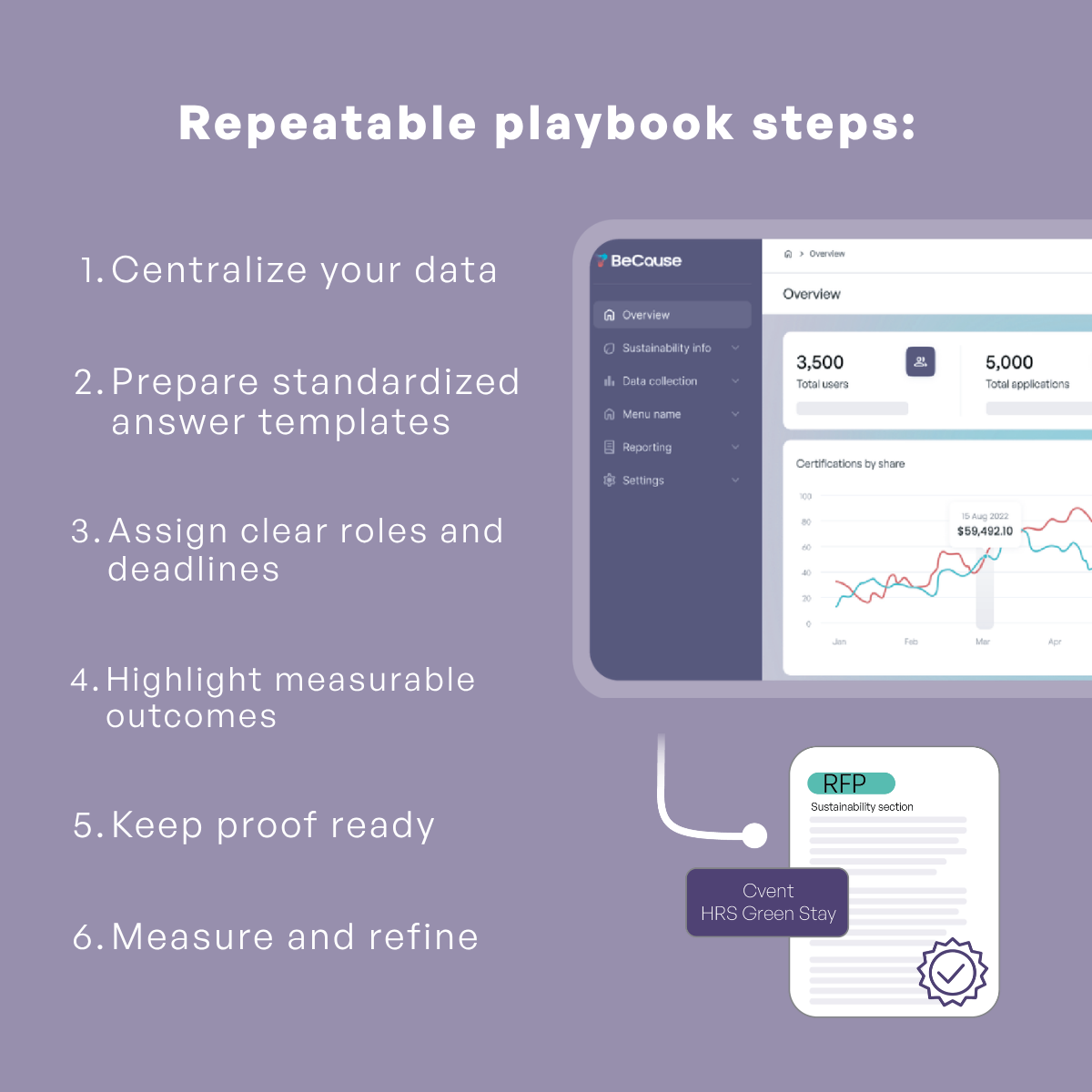
Follow a repeatable RFP playbook
With a reliable data foundation in place, you can focus on response quality instead of firefighting. A simple, repeatable playbook helps
- Centralize your data
- Keep sustainability and operational data in a secure, structured environment, not siloed emails.
- Prepare standardized answer templates
- Create reusable blocks for common questions, including ESG credentials, case studies, and impact metrics, then tailor them to each buyer.
- Assign clear roles and deadlines
- Give subject matter experts ownership of specific sections, use basic project tracking, and build in time for quality and compliance checks.
- Highlight measurable outcomes
- Buyers look for credible numbers: energy use, waste reduction, water savings, community initiatives, and ESG certifications. Showing progress over time is especially powerful.
- Keep proof ready
- Store digital copies of certificates, policies, and audits alongside each property’s profile so you can respond quickly to follow up requests.
- Store digital copies of certificates, policies, and audits alongside each property’s profile so you can respond quickly to follow up requests.
- Measure and refine
- Track metrics such as win rate, shortlist rate, response time, compliance rate, and revenue from RFP driven business. Use these to refine your qualification and response strategy.
Use sustainability data to stand out, not just comply.
Most competitors just tick the required sustainability boxes. But this is an opportunity to use your data to tell a sharper commercial story.
For example, a connected hub lets you:
- Demonstrate portfolio-wide coverage: which percentage of your properties hold recognized certifications.
- Show how automated data flows reduce the risk of outdated or inconsistent claims for corporate buyers.
- Align directly with buyers’ frameworks and CSRD linked expectations by delivering structured, audit ready data, rather than generic marketing copy.
When your proposals show that ESG and data quality are built into your operations, you give procurement teams or corporate buyers confidence that you are a low risk, future ready partner.
How BeCause supports commercial teams
BeCause was built as a sustainability data hub for travel and tourism, with the RFP reality of hotel chains in mind.
It helps commercial and sales teams to:
- Automate ESG data management across properties, aligned with industry standards.
- Connect with RFP software tools like Cvent and HRS Green Stay to auto populate sustainability fields.
- Enable HQ to property workflows so head office can review, approve, and share data without constant back and forth.
- Share up to date certifications instantly with buyers and partners.
With this foundation, your team spends less time chasing answers and more time winning business where sustainability truly matters. Over time, tracking RFP KPIs alongside ESG performance allows you to prove the ROI of your content, your data infrastructure, and your sustainability strategy.
FAQs for hotel RFPs
Q1. What sustainability data should hotels include in corporate RFP responses?
Hotels should include verified carbon emissions per room night, energy mix, water and waste metrics, social impact initiatives, and recognised eco certifications, ideally aligned to standard methodologies like HCMI.
Q2. How does centralising sustainability data improve hotel RFP win rates?
Centralised data reduces response time, improves consistency across bids, and gives buyers confidence that ESG reporting is accurate and auditable, which directly influences scoring and shortlist decisions.
Q3. How can hotels integrate ESG data into platforms like Cvent or HRS Green Stay?
By using a sustainability data hub that connects directly to RFP tools, hotels can auto populate standard ESG fields with up to date metrics, eliminating manual entry and reducing errors.

More resources.


No spam, ever. Unsubscribe anytime.