


Sustainable Travel Certifications for Agencies & Operators



The global travel industry is at a crossroads. As travelers become increasingly conscious of their environmental footprint, sustainability has become a mainstream business imperative. For online travel agencies (OTAs)1, travel management companies (TMCs)2, travel marketplaces and booking platforms3 showcasing credible sustainability certifications is not just about good ethics—it’s a strategic advantage.
[1] An online travel agency (OTA) is a digital platform or website where travellers can search for, compare, and book travel services such as flights, accommodation, car hire, tours, and packages. OTAs act as intermediaries between travel suppliers (like airlines, hotels and tour operators) and customers, offering self-service booking, instant confirmation, and often reviews and price comparisons in one place.
[2] TMC stands for Travel Management Company. A TMC is a specialised agency that plans, books, and manages corporate or business travel for organisations, handling flights, accommodation, ground transport, travel policies, reporting, and traveller support to save costs and ensure compliance.
[3] OTAs, travel marketplaces and booking platforms all sell trips online, but they play slightly different roles. OTAs are branded “one-stop shops” like Expedia that package and sell travel directly to consumers, travel marketplaces are broader digital environments that connect many sellers and buyers (sometimes including peer‑to‑peer or niche suppliers), and booking platforms are the underlying tools or white‑label systems any brand can use to power search, comparison and reservations across flights, stays and experiences.
Whether you’re managing leisure destinations, corporate travel programs, or supply chains of global partners, by promoting suppliers with sustainability certifications signals accountability, transparency, and trust.
This blog explains why certifications matter, breaks down the major sustainability certifications you may encounter, and lists how to operationalize certification data to increase bookings.
Why certifications matter now
36% of travelers intend to stay at a certified property - Booking.com Travel & Sustainability Report 2026
- Travellers increasingly want “more sustainable” options but struggle to understand vague eco-claims; credible labels help them compare hotels and tours on consistent criteria across booking sites.
- Corporate buyers now expect hotel sustainability certifications, concrete emissions data, preferred-supplier lists, and ESG strategy to be reported within business travel proposals. Read more about corporate travel proposals.
- Recognised sustainable travel certification schemes create a common language and baseline for sustainable management, social impact, and environmental performance that can be translated into filters, badges, and reporting.
- OTAs will not be allowed to show certifications that don't comply with the Empower Consumers for the Green Transition Directive.
What is a sustainable travel certification?
A sustainable travel certification is an independent seal or label that shows a hotel, tour operator, or destination has been assessed against defined environmental, social, and governance criteria and meets a verified standard of performance. It usually looks at how the organisation manages energy and emissions, protects nature and culture, treats staff and communities, and embeds continuous improvement into daily operations, then confirms this through documentation reviews and periodic audits rather than self-declared claims.
How sustainable travel certifications work:
- Standards setters (such as the Global Sustainable Tourism Council (GSTC)) define global baseline criteria for hotels, tour operators, and destinations, grouped into pillars like sustainable management, socio-economic benefits, cultural heritage, and environmental impact.
- Certification schemes (various examples in table below) create and maintain the criteria and procedures of a certification standard.
- Certification bodies audit hotels and operators against these criteria and verify that the requirements of the certification scheme are met.
- For OTAs and TMCs, third-party audited labels reduce greenwashing risk, support compliance with rules like the Empower Consumers for the Green Transition Directive, and provide structured data fields that can be surfaced in a search platform and used in ESG reporting.
Major sustainable hotel certifications OTAs will encounter
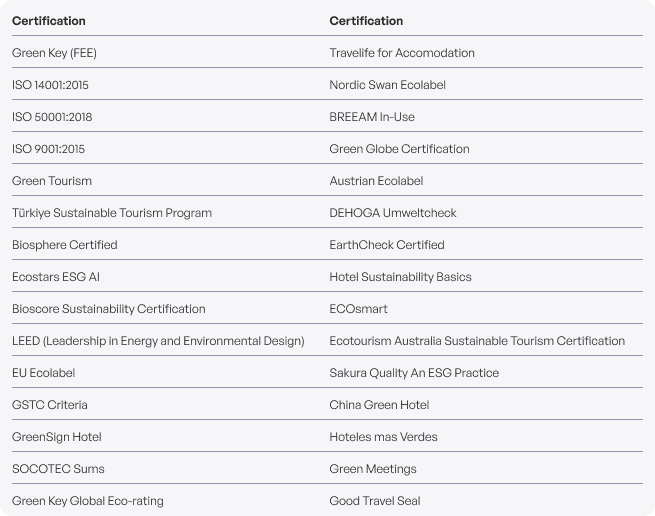
Read our certification resources to learn about the various certifications for hotels.
By mapping these sustainability certifications for hotels into your supplier database (with structured fields like scheme, level and expiry), you unlock consistent filters, sort orders and labels in your hotel search user experience.
How booking platforms can use sustainable travel certifications:
OTAs, marketplaces and TMCs get the most value when they treat certifications for accommodations, tours, Destination Management Companies (DMCs)4 and experiences as data, not just logos.
- Model the data, not the badge: At minimum, capture scheme name (e.g. Travelife, TourCert etc.), level or stage (Engaged/Partner/Certified; Check/full; Bronze/Silver/Gold etc.), scope (tour operator, DMC, attraction, inbound only), validity dates and last audit date. Storing this in your supplier master data lets you run consistent queries across very different labels.
- Build filters and ranking rules: Use structured certification fields to power filters like “Third-party certified experiences”, and to boost certified operators in default sort orders where appropriate.
- Clarify to users what each label means: In consumer and corporate interfaces, pair badges with short, plain language explanations – for example, rollovers that summarise what certification covers, without technical jargon. This reduces confusion caused by “logo soup” and helps travellers and travel managers make informed trade-offs between price, experience and impact.
- Support procurement and ESG reporting: Procurement teams can reference recognised tour operator and TMC certifications directly in request for proposal templates, preferred supplier criteria and scorecards, alongside hotel schemes. On the reporting side, trip data allows dashboards to show the percentage of tours or experiences booked through sustainably third-party certified suppliers by region, program, supporting CSRD style disclosures and internal ESG targets.
- Manage greenwashing risk: Relying on independent, third-party verified certifications for nonhotel services gives your platform defensible evidence for sustainability claims, which is increasingly important under regulations such as the EU Green Claims Directive and EmpCo. Having certificate IDs, validity and audit information on record also makes it easier to spot expired or downgraded statuses, and an opportunity to automate reminders about expiry coming up to notify suppliers.
[4] DMC stands for Destination Management Company. It is a local expert company that designs, organizes, and manages on-the-ground services in a specific destination, such as accommodation, transport, activities, events, and logistics, often on behalf of tour operators, travel agents, or corporate clients.
BeCause centralises certification and ESG data, making it easier for OTAs to see which partners already meet standards and where the gaps are. BeCause streamlines the process of collecting, verifying and updating certification evidence, so your marketplace can present trustworthy sustainability certifications in your platform.

Certifications for tour operators, DMCs and experiences:
Sustainable travel certification is just as important beyond the hotel. Some sustainability certifications just for tour operators, DMCs and experiences include:
- Good Travel Seal: is for tourism businesses, including tour operators, DMCs and experience providers, that meet clear environmental, social and quality criteria. It offers three progressive levels aligned with international standards (GSTC and Travalyst).
- GSTC industry criteria for tour operators mirror the hotel criteria and provide a standard for responsible product design, community benefits, cultural respect and environmental management in tours and ground services.
- Travelife for tour operators and travel agents offers a three-stage pathway (Engaged, Partner, Certified), with the highest “Travelife Certified” level audited on-site and formally recognised as meeting GSTC’s industry criteria. Because Travelife Certified status requires an on site audit and broad coverage of environmental and social topics, many industry guides consider it one of the most credible options for globally active operators and agencies.
- TourCert (Europe centric): TourCert focuses on tour operators and travel agencies and combines sustainability and corporate responsibility requirements with management system elements aligned to ISO and EMAS. It offers an entry level “TourCert Check” as a stepping stone to full certification, which can help platforms distinguish between suppliers that are just starting versus those with a mature sustainability system.
- Preferred by Nature now manages the former Rainforest Alliance sustainable tourism standard for hotels and inbound tour operators, recognised by GSTC. For DMCs in Latin America and other nature based destinations, this seal signals strong focus on biodiversity, ecosystems and local livelihoods and can be especially relevant to adventure and eco tour marketplaces.
These schemes make it easier for OTAs and TMCs to assess DMCs, day-tour providers and experience partners, then filter and prioritise them in both consumer and corporate interfaces as part of sustainable travel initiatives.
How OTAs and TMCs can operationalise certifications
Turning sustainable travel certifications into commercial outcomes requires coordinated work across supply, product, data and sales.
1. Supply and contracting
- Prioritize suppliers with third-party recognised hotel sustainability certifications or tour-operator labels when onboarding or renewing, and make certification status part of your scorecards.
- Include sustainability fields and minimum expectations in preferred-supplier programs, especially for corporate travel buyers.
2. Product and UX
- Standardize icons and tooltips for sustainable hotel certification and tour labels so that travellers see consistent signals across listings, not a confusing mix of logos. These will need to be aligned with the EmpCo.
- Offer filters such as “Certified sustainable stays” or “GSTC aligned tours” and explain in simple content pages what each major label covers to build trust and reduce confusion.
3. Data and reporting for buyer
- Combine supplier certifications with emissions data in dashboards that show corporate clients the share of certified nights, trips and spend by destination, chain or route.
- Use these datasets to support ESG reporting, such as disclosures aligned with CSRD or voluntary frameworks, and to document the impact of sustainable travel initiatives.
4. Risk, compliance and greenwashing
- Relying on independent certifications and auditable emissions data reduces the risk of misleading environmental claims and supports compliance with regulations like the EU Green Claims Directive.
- Clear internal guidelines on acceptable sustainability claims, backed by certifications and metrics, protect your brand and offer corporate clients defensible documentation for their own ESG reporting.
EU green claims rules: what OTAs and tour operators can (and can’t) say
The EU’s Empowering Consumers for the Green Transition Directive is designed to protect consumers from greenwashing by banning vague or unsubstantiated environmental claims and requiring clear, evidence based information at the point of sale. For OTAs and tour operators, this means any sustainability labels, badges or messages they display must be backed by reliable, verifiable data and recognised schemes, and they will no longer be allowed to use generic “green” or “eco friendly” claims or unverified logos in their listings and marketing.
The Directive will apply from 27 September 2026, meaning marketplaces now have a limited window to clean up sustainability claims and redesign how they display green labels and messaging to EU consumers.
A simple summary is available in our new blog: The EU Green Transition Rules: What Tourism Businesses Need to Do
Choosing which certifications to prioritise
With dozens of eco-labels in the market, OTAs and TMCs need a simple framework to prioritise.
Start with these 3 steps:
- Start with globally recognized standards for hotels and tour operators (i.e. GSTC recognized or Travalyst recognized) so that your sustainable hotel certification portfolio rests on widely accepted criteria.
- Consider geography (regional ecolabels), segment (urban vs. resort vs. adventure) and current supplier footprint to choose the most relevant schemes.
- Evaluate data accessibility and audit robustness: favour programs with transparent registries, regular on-site audits and the ability to share certification data digitally through partners like BeCause. In parallel, emerging regulations such as the EU’s CSRD and related sustainability standards, will make reliable, audit ready data a legal requirement rather than a voluntary commitment.

Questions to ask about any certification:
Scope: What activities and impacts do the certification cover?
Recognition: Is it aligned to a global travel & tourism authority with widely used criteria?
Data access: How easily can you access and verify certification data for thousands of suppliers?
Audit quality: Are audits conducted by accredited, third-party certification bodies?
Making certifications work harder
BeCause is an ESG and sustainability data platform designed to centralise and streamline sustainability data for travel, tourism and hospitality – including certifications. BeCause unifies certification frameworks and ESG data in one system, allowing destinations, OTAs and TMCs to showcase certified entities, stream data into booking platforms, and maintain a live overview of who is certified and to what level. By mapping certifications directly to your internal KPIs and dashboards, you can track coverage, identify gaps, and give both travellers and corporate clients transparent, audit-ready sustainability information.
Takeaways for OTAs and TMCs
- Treat sustainable hotel certification and tour-operator labels as structured data, not just logos.
- Anchor your sustainable travel initiatives in industry aligned standards and robust ESG data.
- Use platforms, like BeCause, to automate certification mapping, ESG reporting and partner collaboration so sustainability becomes an integrated part of your product, UX and sales story.


More resources.


No spam, ever. Unsubscribe anytime.