Most travel buyers assume hotels send sustainability data manually, platform by platform. Here's how the collect-once use-everywhere model actually works — and what it means for procurement teams requesting it.
If you manage supplier sustainability requirements for an Online Travel Agency (OTA), a Travel Management Company (TMC), or a corporate travel program, you've probably wondered what's happening on the hotel side when you request ESG data. The short answer: it depends entirely on whether the hotel has a sustainability data hub or not.
Without one, a sustainability manager is manually pulling data from utility dashboards, spreadsheets, and individual property managers, then reformatting it for each platform that asks. With one, the same data flows automatically to 140+ booking platforms, OTAs, certification bodies, and RFP (Request for Proposal) portals from a single submission. Any gaps in data quality, consistency, and turnaround time are substantial enough to create real problems downstream — for OTA listings, supplier scorecards, and corporate travel reporting alike.
Here's how it actually works.
How hotel sustainability data distribution works
The problem with manual sustainability data submissions
Until recently, most hotels handled sustainability data requests the same way they handled everything else: manually. A request arrives from a booking platform. Someone emails the chief engineer. Someone else digs through last year's utility bills. The numbers get formatted into whatever template the platform requires, submitted, and in many cases never updated again until the next request arrives.
The result is data that's inconsistent across platforms, often months out of date, and difficult to verify. A hotel might report one carbon intensity figure to your program and a different one on their OTA listing — not because they're being dishonest, but because two people pulled from different sources at different times.
For OTAs and TMCs trying to meet their own ESG disclosure requirements, or filter suppliers by sustainability criteria, that's a real problem. You can't build reliable reporting on top of unreliable inputs.
Why this matters for travel buyers: Corporate travel policies and OTA sustainability filters are only as credible as the hotel data underneath them. If a hotel's sustainability credentials are self-reported without a standardized collection process, the data quality is unknown.
What "collect once, use everywhere" means in practice
The collect-once use-everywhere model starts with a hotel entering its sustainability data into a central platform once: energy consumption by property, water usage, waste figures, certification status, carbon data. From there, the platform structures that data against multiple frameworks simultaneously and distributes it through API connections to every channel that requests it.
When a hotel's Green Key certification status is updated by the certification body in BeCause, that update publishes automatically to Google Travel, Booking.com, Cvent, and any other connected channel. The hotel doesn't need to log into each platform separately. Travel buyers don't need to chase updated data.
For a buyer, that means the sustainability data on your supplier portal and the data on the hotel's OTA listing come from the same source, updated at the same time.
How certification data specifically gets distributed
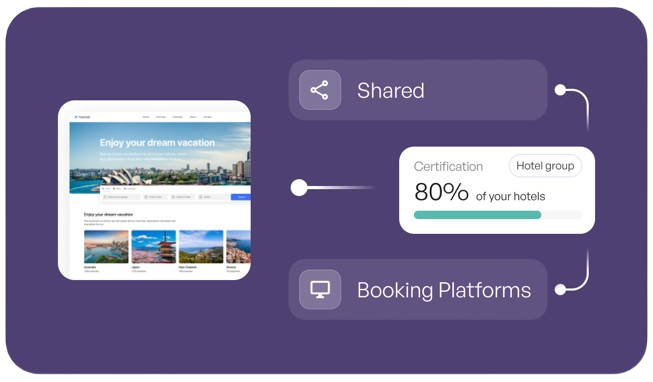
Certification status is often the data point travel buyers rely on most. It's externally managed, specific, and more meaningful than self-reported metrics. But the distribution of certification data has historically been fragmented. A hotel gets certified by Green Key or EarthCheck, the certification body issues the credential, and then someone manually updates the hotel's listing on whatever platforms they remember to update.
With a sustainability data hub, certification data flows differently. BeCause connects directly to certification bodies — the data comes from them, not from the hotel. That distinction matters: it means certification status on any connected platform isn't self-reported by the property. It's pulled from the source that issued it, in real time. When a certification is renewed, lapses, or changes scope, that status updates across all connected channels automatically.
The practical implication: if you're filtering hotel suppliers by certification status on Booking.com, Google Travel, or a corporate booking tool, you're looking at data that's current and not self-reported. For procurement teams running supplier audits, that removes a whole category of data reliability questions.
What to ask hotel partners: "Is your certification status connected to your booking platform listings, or do you update them manually?" The answer tells you a lot about data reliability.
What standardized data looks like when it arrives
OTAs and TMCs receive hotel sustainability data in dozens of different formats: some structured, some not, some using different units for the same metric, some mapping to different framework definitions. Before you can use it, someone has to clean it.
Data distributed through BeCause arrives pre-structured: energy intensity in kWh per square meter, carbon intensity per occupied room, water usage per guest night, certification status with issue date and expiry. All in the format the receiving platform expects. The hotel doesn't need to know how Booking.com wants the data formatted versus how your TMC travel policy portal requires it. The platform handles the translation.
If you're building a supplier sustainability scorecard or feeding hotel data into your own ESG disclosure, the difference between structured and unstructured input is days of work. For a hotel portfolio, it is weeks of work.
The corporate proposal: how hotel sustainability data reaches your procurement process
Sustainability questions now appear in most corporate travel RFPs. Hotels that manage their data through a central platform can pull pre-formatted responses directly from it, rather than assembling answers from scratch for each submission.
Hotels without a data platform tend to leave sustainability sections incomplete, submit inconsistent figures, or pull from outdated reports. Hotels using a platform can answer sustainability questions in the same turnaround time as operational questions, because the data is already structured and ready to export.
If your RFP process includes sustainability criteria, asking hotels whether they use a sustainability data platform is a useful pre-qualification filter. It signals both data reliability and operational maturity on ESG.
Useful RFP screening question: "What sustainability data platform do you use, and which certification bodies and reporting frameworks are you currently mapped to?" Hotels that can answer this specifically are far more likely to provide reliable, consistent data throughout the contract period.
What travel buyers should require from hotel sustainability data
The sustainability data landscape in hospitality is maturing quickly, but standards for what travel buyers should expect from hotel partners are still catching up. Here's a practical baseline.
- Third-party certification status, not just self-reported claims. Certification bodies that connect directly to distribution platforms provide a verifiable signal — more reliable than a hotel asserting they follow a framework without external validation.
- Data with a timestamp. Sustainability metrics age quickly. Useful data includes when it was collected and for which reporting period — not just the figure itself.
- Consistency across platforms. If a hotel's sustainability data looks different on Booking.com than it does in your supplier portal, that's a data governance problem worth investigating before it becomes a reporting problem for you.
- Framework alignment, not just raw metrics. Energy consumption figures are only comparable if they're calculated against the same methodology. Ask which frameworks the hotel reports to — HCMI/HWMI, GBTA, VSME — and whether that data is mapped by a platform or manually translated.
- Portfolio-level data for hotel groups. A hotel chain managing 200 properties should be able to provide standardized data across all of them, not just the flagship properties with active sustainability managers.
What this means for your supplier requirements
Travel buyers who set clear data requirements now are better positioned to meet their own ESG reporting obligations as disclosure requirements tighten. The practical ask is straightforward: certification data connected to distribution channels, standardized formats, and a timestamp on every metric.
The hotels best able to meet those requirements are ones using a purpose-built sustainability data hub. They have the data infrastructure to prove what they're doing and share it reliably across every platform that asks. That's a meaningful filter when you're managing hundreds of supplier relationships.
BeCause is that infrastructure. We connect hotels, certification bodies, and 140+ booking platforms so sustainability data flows where it needs to go: structured, current, and entered once.
For OTAs, TMCs & corporate buyers
See how BeCause connects your supplier data
BeCause is the sustainability data hub for travel, tourism, and hospitality — connecting 70,000+ properties to 140+ booking platforms across 80+ certifications.
Explore the platform →